

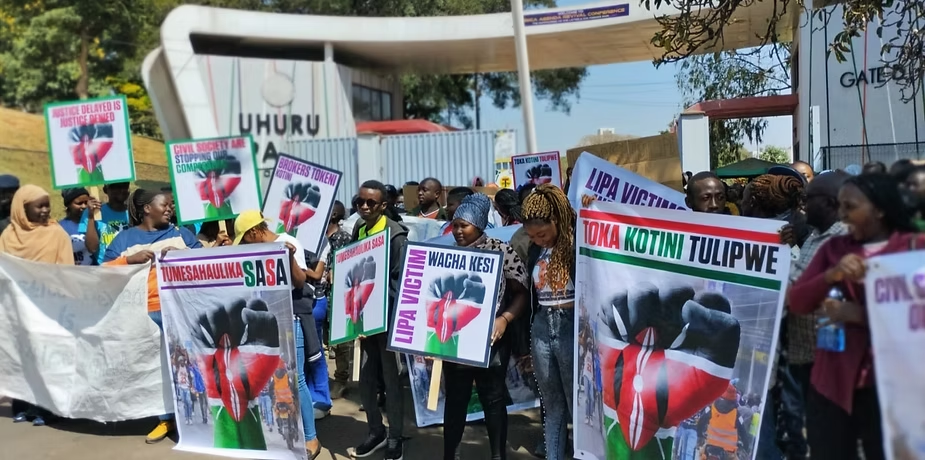


With the legal hurdles now cleared, compensation for victims of violent policing during protests is back on the table. The Kenya National Commission on Human Rights, now affirmed as the constitutional body tasked with delivering the President’s pledge, must define its path and steer clear of new obstacles.
Two weeks ago, this column noted the absence of a budgetary allocation for this exercise in the supplementary budgets. Within days, the President confirmed Sh 2 billion would be available for the exercise. He also urged the KNCHR to develop a national reparations framework. On 17 March, the KNCHR publicly invited survivors and victims’ families to submit their documentation to nine of their offices by 3 April for verification.
This week, KNCHR also announced that it has begun developing a comprehensive framework and standardised protocols for restitution, public apologies, and financial compensation. This framework must fulfil public expectations for reparations, justice in our courts, memorialisation and laws, policies and strategies for non-recurrence of the state violence we have seen in streets and communities across Kenya.
There are at least five obstacles the Commission might face. While the Nairobi, Kitale, Kisumu, Mombasa, Nyahururu, Wajir, Kajiado, Isiolo, and Garissa offices provide for devolved access for victims, those who find this challenging will be forced to use the toll-free telephone and email contacts to communicate or request assistance in submitting their documentation. Families and survivors must directly submit to the KNCHR officers, not other state agencies, NGOs, brokers, or that peculiar “guy” who promises a hook-up. KNCHR must ensure that its offices and phone lines are professionally staffed at all times.
The process must go beyond financial compensation, ensure accountability, and non-recurrence. Survivors and victims’ families have been clear that they want to see perpetrators face justice in a court of law. They also want to see an end to the violence. No more Baby Pendo, Rex Masai, Eric Shieni, Abdi Kadir, Bridget Njoki, or the other 300 plus cases since 2017.
While financial compensation can only be symbolic and an acknowledgment that the state has committed horror and harm against its citizens, it is important that the amounts awarded be dignified and respectful. Treasury needs to take note that Sh 2 billion is likely to be insufficient to respond to all the deaths, permanent disabilities, serious injuries, and the needs of indirect victims, the affected dependents, and families. The operational costs of framework design, verification, communication and hearings for the affected are themselves daunting for this historically defunded commission.
What criteria will be used to compensate those who have lost their right to life, liberty, endured physical and emotional torture, disability, enforced disappearances, and are still missing? Will only those murdered or maimed on our streets be compensated? What about those killed in police custody after protests? How will the KNCHR determine awards to those who are single and those who are breadwinners with dependents?
The Commission has warned that fraudulent claims will be prosecuted. It must build systems to detect false and falsified P3 forms, medical reports, OB reports, and post-mortem reports while supporting families lacking genuine documentation. Cases of officers killed or injured should be referred to the Police Inspector General for consideration under the Endowment Fund, Group Life Assurance, and Welfare schemes.
A profoundly sensitive social process that will trigger psychosocial mass trauma, how will those directly affected be emotionally supported as they embark on this journey to justice? How can their voices become mainstream? Perhaps the KNCHR needs a victims’ representatives council as a sounding board to guide the process.
The KNCHR has a mammoth, sensitive task ahead of it. Their efforts must be grounded in a deep understanding of, and commitment to, human rights law, as well as lessons from other countries that have successfully implemented restorative justice projects. Previous columns have argued that this process can succeed if the exercise is grounded in a victim-centred approach, is evidence-based, transparent, comprehensive, and independent. We must support the KNCHR to deliver this for survivors and victims’ families.
Irũngũ Houghton is Amnesty International Kenya Executive Director and writes in his personal capacity. Email: [email protected]