
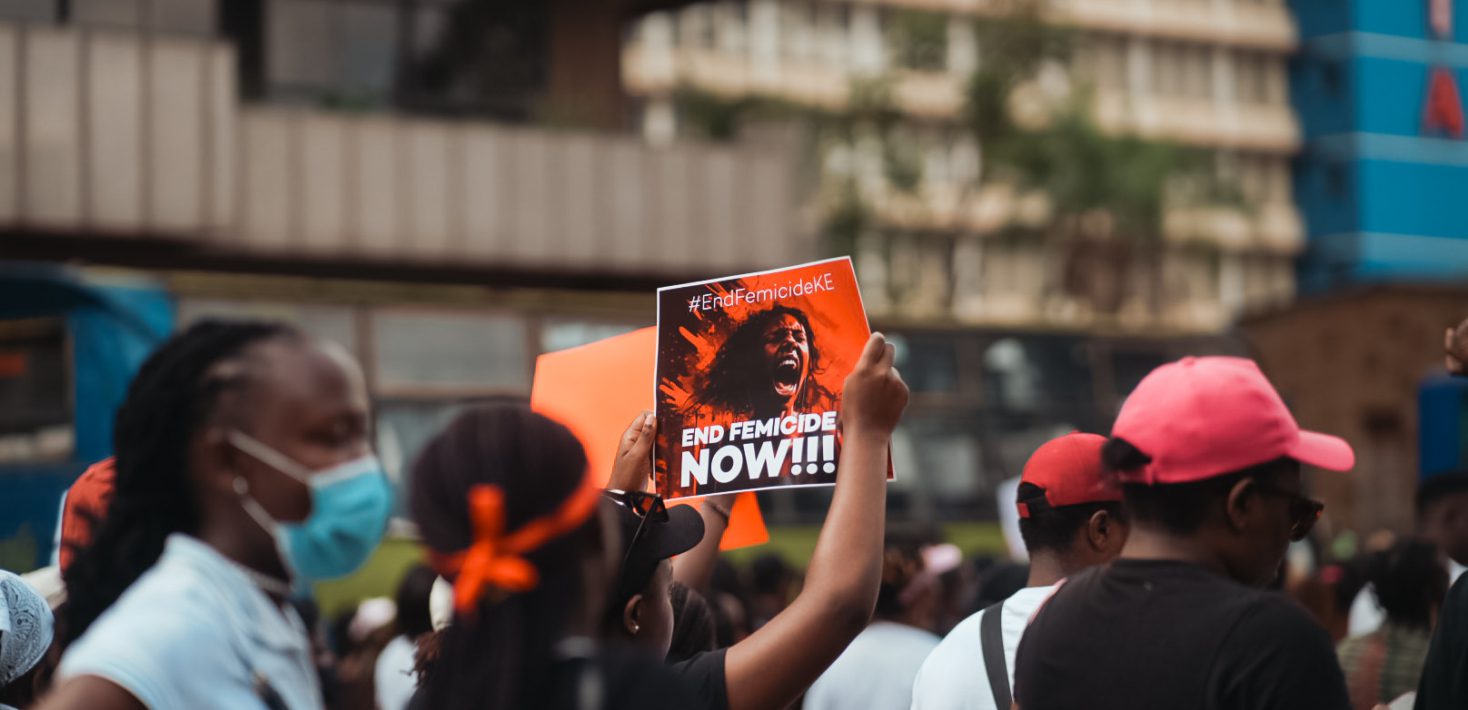


Diana Russell, a pioneer researcher on violence against women, is credited as having popularized the use of the term ‘femicide’ to describe the killing of women because of their gender. She used the term publicly when she testified on the crimes against women during the first International Tribunal on Crimes Against Women held in Belgium in 1976. In a 2022 report, UN Women and UNODC estimated that in 2023, Africa had over 20,000 women killed by their partners. The Initiative for Strategic Litigation (ISLA) is trying to hold states accountable for failure to tackle this crime and is advocating for the inclusion of femicide as a crime within African legal systems.
NAMING THE UNNAMED
In May 2025, my seven-year-old niece lost her friend and playmate to femicide. Tamara Blessing Kabura, also seven years old, was bright-eyed and just beginning to grasp the world. She was raped, murdered, and buried in the perpetrator’s house in Nyeri, Kenya. Her death joins a long, uncounted list of gendered killings in Africa.
Although efforts to combat Gender-based violence (GBV) across Africa have been made, no country in Africa has a standalone law specifically and explicitly defining or criminalizing femicide as a distinct crime in the law. Some countries have taken limited legal or policy steps that acknowledge femicide. However, the law still treats femicide as a personal misfortune rather than a failure of the state.
Globally, different jurisdictions have had varied responses to femicide. Most countries in Latin America have criminalised the gender-related killing of women, either under a legal definition of ‘femicide’ or ‘feminicide’, though definitions and enforcement of the laws vary. The 2009 Cotton field judgement against Mexico was pivotal in shifting from individual prosecution to state responsibility for violence against women. In 2012, Mexico classified femicide as a specific crime within its federal penal code. In March 2025, the Italian government introduced a draft law that gives a legal definition of the crime of femicide and punishes it with life imprisonment. While the bill still needs Parliament’s approval, its introduction is a step in the right direction.
THE PERSONAL IS POLITICAL: WHEN THE LAW KILLS TWICE
Generally, the laws in African jurisdictions do not recognise the gendered motivation behind the killing of women and girls. The crime of murder or attempted murder is treated as a gender-neutral crime. Without this distinction, patterns of GBV (e.g, intimate partner violence, rape, defilement, stalking, etc.) are obscured. Consequently, the state cannot be held accountable for the failure to prevent femicide.
If the states of Burundi and Kenya recognised femicide and attempted femicide as a crime, then Francine Nijimbere’s and Jackline Mwende’s husbands would have been charged accordingly. Francine Nijimbere’s husband cut off her arms up to the elbow for failure to give birth to a son in 2004 in Burundi. This was Francine’s second husband and brother-in-law, as her first husband had died in 2000, five months after their wedding. Francine had been coerced into the marriage by her in-laws, asserting that the dowry had already been paid. Twelve years later in Kenya, Jackline Mwende suffered the same fate. Her husband chopped off her arms because she was unable to conceive during their seven-year marriage. Jackline’s husband was convicted of attempted murder and sentenced to 30 years in prison. Francine’s husband, however, was imprisoned for only a short time, as he was released in 2007 through a presidential pardon. Francine had to flee her home because her husband had sworn to “finish her off”. Because attempted femicide is not recognised as a crime, the failure of the states to fulfil their obligations under Article 4 of the Maputo Protocol is not apparent.
Back in Kenya, the trial of the murder of Ivy Wangechi, a final year medical student at Moi University, further reflects the failure of the law to link violence against women to a failure of the state. Throughout the judgment, it is clear that the perpetrator had been stalking the deceased for years in a bid to initiate a romantic relationship with her. However, the deceased was clear that she was uninterested and communicated the same to the perpetrator on multiple occasions. However, the perpetrator was adamant to the extent of using the deceased’s friends to plead his case on his behalf. Eventually, he killed Ivy by striking her with an axe on the head and neck at Moi Teaching and Referral Hospital in Eldoret, where Ivy was schooling.
The law, as it is in Kenya, provides for the ingredients of the crime of murder, limiting the act of killing to an isolated act divorced from broader social patterns. By only focusing on whether the person intended to kill (malice aforethought), the law ignores the systemic conditions that allow femicide to recur. Failure of the law to name the killing of women like Ivy as ‘femicide’ is a failure to acknowledge a broader pattern of gender-based violence in our societies. Unfortunately, African legal systems are narrowly focused on the motives of the individuals who kill women and girls rather than the gendered systems of power that normalise these murders.
STRATEGIC LITIGATION AS RESISTANCE AND RECORD
All across Africa, feminist lawyers are increasingly using strategic litigation as a tool for social change. Although the perpetrators of femicide are often charged with murder or attempted murder, feminist organisations often use public commentary and amicus briefs where the law allows to link the murder to a broader culture of misogyny.
In 2019, the brutal killing of Uyinene Mretyana, a 19-year-old university student from South Africa, sent shockwaves across the country. Uyinene was raped and killed by a post office worker when she went to pick up a parcel at the Cape Town post office. Sadly, her death was one of the many cases of women who are sexually assaulted and killed by men in positions of trust and power. Uyinene’s family and feminist activists ensured that the subsequent trial not only secured a conviction but also exposed the failure of the state to prevent violence against women. Further, a protest donning the hashtag #AmINext took over Cape Town shortly after Uyinene’s burial, highlighting the government’s inadequacy in protecting women from violence. The pressure led to the National Strategic Plan on Gender-Based Violence and Femicide being established. In 2024, the National Council on Gender-Based Violence and Femicide Act was enacted. The act establishes a council to coordinate efforts in combating GBV and femicide.
Litigation on its own cannot end femicide. However, when feminist lawyers like me litigate strategically in cases where women are murdered, the courtroom becomes a space for truth-telling. We argue that not only did a man kill a woman or girl, but that the state allowed it to happen. The state failed to prevent the murder due to a lack of reaction to misogyny. The court documents detail the number of times the state failed the woman.
Strategic litigation is a powerful tool for holding states accountable in cases of violence against women, including femicide. It compels states to confront their failure to protect women and girls from violence. The Cotton Field case in Mexico, as well as the Uyinene trial in South Africa, resulted in legal changes providing for the crime of femicide. When Courts affirm that femicide is not a personal tragedy, but a systemic injustice rooted in state inaction, legal reforms and shifting narratives follow. To prevent femicide, states must urgently (1) invest in social services and prevention programs that address the root causes of GBV, including engaging young men and boys in unpacking patriarchal dominance, (2) adopt specific laws on femicide that highlight the gendered nature of woman killing, and (3) ensure timely and survivor-centred investigations and prosecutions of femicide cases.
Wangui Gitahi is Amnesty International Kenya Senior Protection Officer and writes in her personal capacity.