

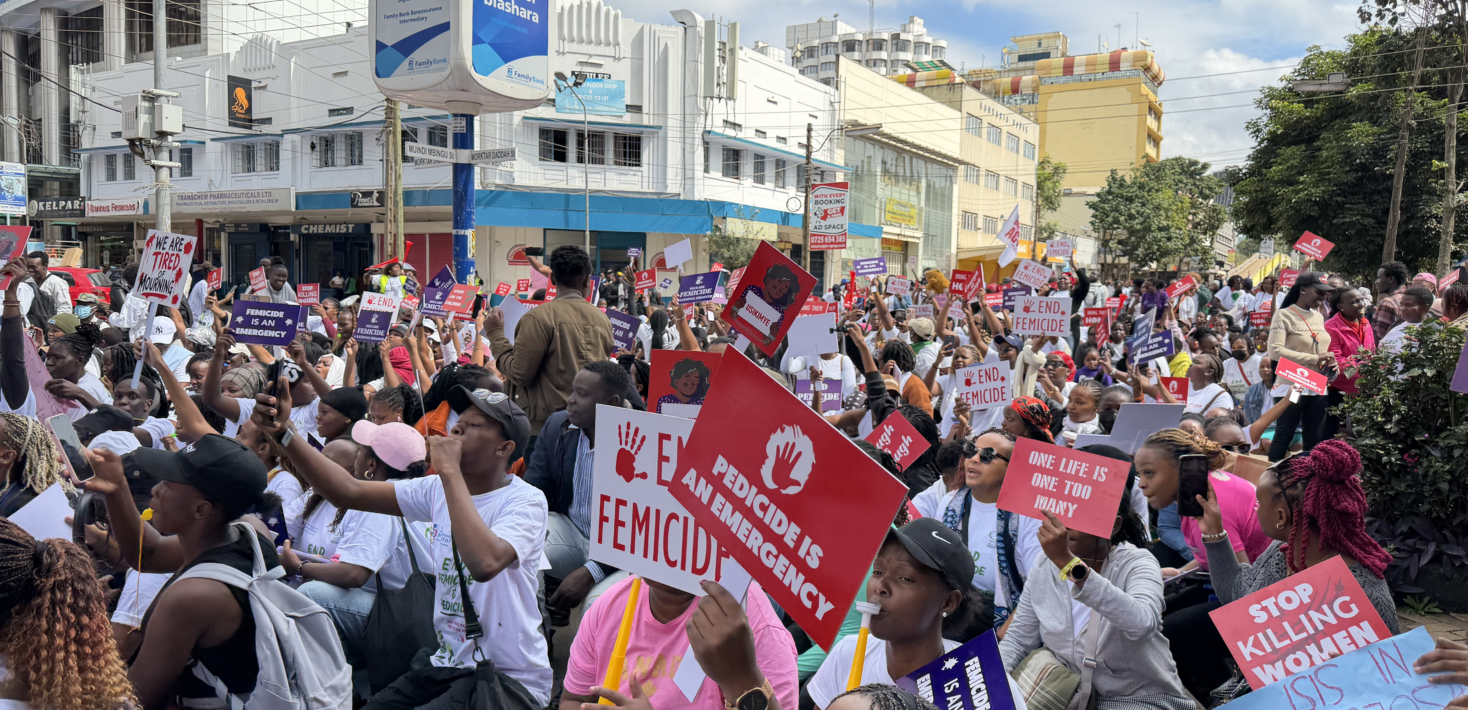


With 16 Utumishi Girls Academy students dead and 74 injured, the nation reels from another horrific tragic incident. As feminists are forced to organize another public memorial this coming Madaraka Day, what would it take to keep all Kenya’s women and children safe?
Public, parental and policymakers’ attention has been recently gripped by the seemingly endless testimonies and reports of femicide, pedicide and missing children since Missing Children’s Day (ironically also Africa Liberation Day, 25 May 2026). The Kenya Gender Ministry Directorate of Children Services informs us that 10,581 children went missing between January 2025 and March 2026. This is a staggering 23 children a day. Proportionately, Kenya ranks among the highest globally for missing children. We are behind South Africa (one child every five hours), the U.S., and the U.K., with their robust reporting systems, and conflict zones like Sudan and the DRC. Japan, Finland, and Switzerland, on the other hand, report the lowest rates.
According to the Gender Ministry, parental abandonment, abductions, trafficking, and the structural violence of poverty drive these statistics. While nearly 4 out of 5 children are eventually found and reunited with family, one child never comes home. The stories have been heartbreaking. A Pokot boy abducted for a harmful ritual, a child’s body found in a Nyeri pit latrine, a Thika secondary student found after 5 weeks, and a minor rescued en route to Tanzania, among others. Sadly, we have to learn another deadly word, pedicide, from the Greek and Latin words, paidos (child) and caedere (to kill), respectively.
Public anger mounts over the government’s failure to decisively act on the GBV Taskforce report submitted in May 2025. Readers will recognize the snail’s-pace approach to tackling one of Kenya’s gravest crises. Since the handover to the President in November, given current trends, more than 200 women, including gospel singer Rachel Wandeto, may have been killed
What can our 47+1 governments, communities, civic, and business organizations do to reverse these terrible stories and statistics? Our State bears the primary responsibility for promoting and protecting all human rights for all human beings. Inaction, paralysis, or delay in responding to this national crisis leaves the State vulnerable to the charge that it is failing its constitutional responsibility.
The silence and inaction by the President and 47 Governors is deafening, especially as the Baraza GBV Taskforce has completed its recommendations. To restore public trust, the Presidency and Gender Ministry could unbundle the recommendations and publicly report specific progress on the legislative, budgetary, and operational recommendations.
Community and residential associations, businesses, and feminist organizations must also step up their game. Public memorials and street demonstrations like the ones planned for Monday have their place in stirring national conscience and offering solidarity to the fallen and those at risk. However, without helplines, safe spaces, and survivor-led networks leading preventative public awareness campaigns, we will not bring these rates down.
We must redesign our homes, places of worship, work, and entertainment as “zero-tolerance” zones. We can train each other on how to safely intervene in situations of harassment and violence. Every neighborhood, street, court, and village needs a focal point not just to respond when needed but to proactively introduce feminist family values. Our creative artists need to paint, sing, and perform to challenge pervasive harmful gender norms, victim blaming, and spark skillful non-judgemental dialogues.
Ending the deep-seated entitlement some feel they have over other people’s bodies may seem impossible, but as freedom writer Micere Githae Mugo reminded us, ta’imagini it is not. If Kenyans learned to respect a simple ‘no’ from either a child or an adult and chose to walk away instead of lashing out at someone weaker, we could cut these horrific statistics in half.
As the EndFemicide movement gathers concerned citizens at Nairobi’s Jeevanjee Gardens on Monday at 9 a.m., their rallying cry “Not Yet Madaraka for the nation’s women and children” must echo into every home. On this Madaraka Day, let’s dedicate our freedom to ending the scourge of missing children, femicide, and pedicide. Lives depend on it.
Irũngũ Houghton writes in his personal capacity. Email: [email protected]