
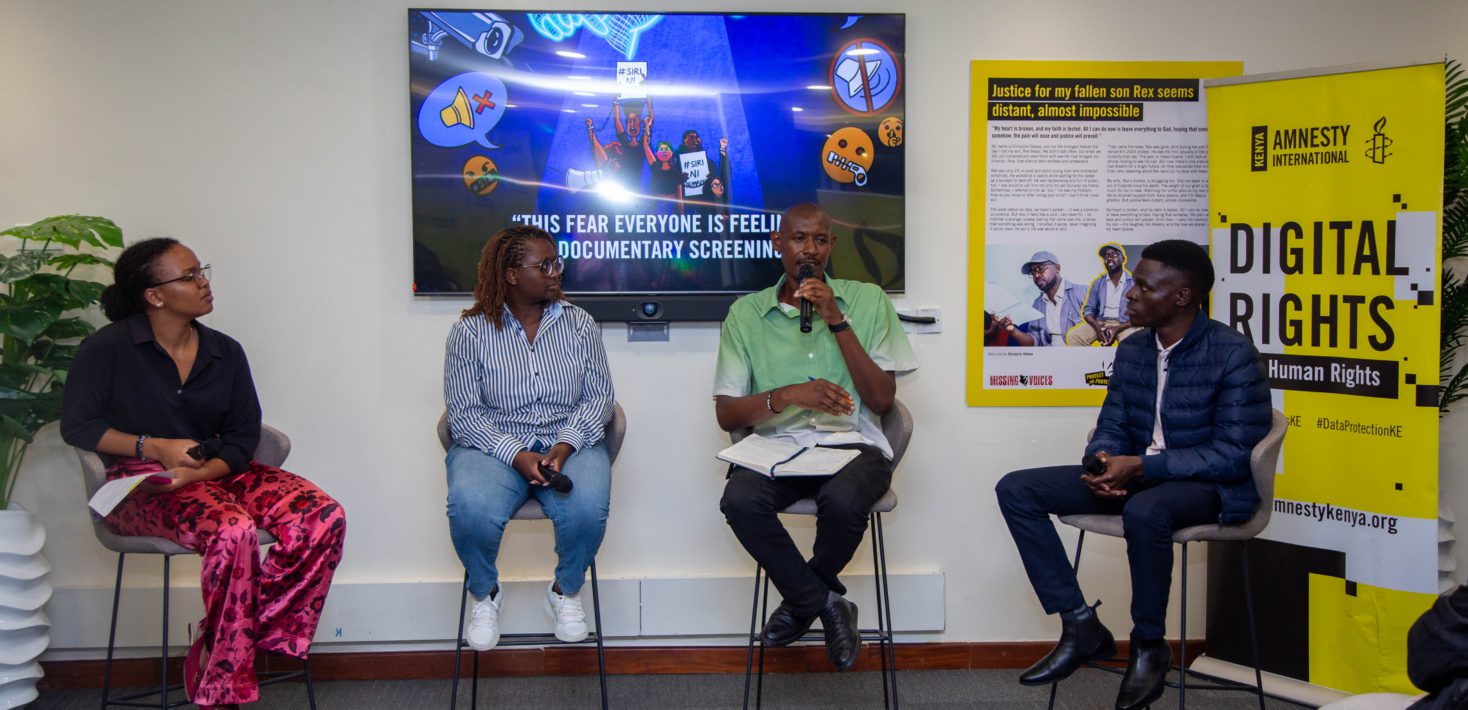


On 10th April 2026, we held an Amnesty Kikao, a community gathering built around the screening of our latest report, “This Fear, Everyone Is Feeling It”: Tech-Facilitated Violence Against Young Activists in Kenya. What was meant to be a conversation about a research report became something much more powerful: a room full of people refusing to be spectators to their own oppression.
The report documents something many of us already feel in our bones: that the same digital platforms that gave Kenya’s Gen Z protesters their voice were weaponized against them. There were coordinated disinformation networks, AI-generated pornographic images were used to silence women activists, surveillance was allegedly enabled through mobile data, and enforced disappearances of people who posted online.
These are not abstract human rights violations. They are happening to young people in Nairobi, Mombasa, and Kisumu; people with children, with landlords, with communities who have been pressured to distance themselves out of fear. Bringing the report back into the community, it was written about something that had changed in the room. Numbers became neighbors. Statistics became stories.
One of the most energizing moments of the evening came not from the report itself, but from the solutions already being built right here.
There is Embrace, an app designed specifically to allow survivors of tech-facilitated gender-based violence to report incidents and be connected directly to mental health practitioners on the platform. No bureaucratic detours. No victim-blaming intake processes. Just immediate, dignified support. Built for this context by people who understand it.
There is also the Community Journalists model: locally based researchers and storytellers gathering their own data, documenting their own realities, and not waiting for large international organizations to arrive and validate what they already know is happening. This kind of work matters enormously. It means that human rights evidence is no longer something that happens to communities but something communities produce, own, and act on.
This is what “think global, act local” actually looks like when it stops being a slogan.
As a tech and human rights campaigner, I work with data, legal frameworks, and platform accountability arguments every day. But something important happens when you sit in a room and hear a young woman describe how she was profiled as a violent protester by the police. Or when you hear an activist explain that the joy, the spark, that drove his work was slowly extinguished by strangers targeting his identity online, every single day.
As Mercy Mutemi put it plainly: we need to actually support our local solutions. Not just celebrate them. Not just amplify them online and move on. Fund them. Use them. Build ecosystems around them.
Because here is what violators, whether governments, disinformation networks, or negligent tech platforms, are counting on: that we remain fragmented. That activists keep fighting alone. That the tools remain underfunded. The community keeps watching and waiting for someone else to fix it.
What the Kikao showed is that the counter to tech-facilitated violence is not only better policy or platform accountability, though we need both urgently. It is also this: people who refuse to let fear be the last word, building things together, in community, for community.
Sharlene Muthuri is Amnesty International Kenya, Technology & Human Rights Campaigns Officer, and writes in her personal capacity.