



This week’s vicious public attack on Vihiga Senator Godfrey Osotsi, captured on CCTV and carried out in a busy commercial space, shatters any lingering illusion that Kenya’s next General Election will be calm, rules‑based, or insulated from violence. Now that we have another example of political violence, what would a responsible security management strategy look like?
As the Senator was taking coffee in one of Kisumu’s most frequented malls and coffee houses, he was brazenly attacked several times by several assailants. For several minutes, the Senator is savagely punched and kicked as his attackers loudly accuse him of being against President William Ruto. The incident confirms a deepening pattern of organized political goonism, weak deterrence, and selective policing. Violence is becoming a tool of political intimidation with near‑total impunity
While his allies in the Linda Mwananchi movement have condemned the attack, there has been no public response from the Police Inspector General, the Interior Principal Secretary, or the Cabinet Secretary. The Interior PS has remained silent despite a circulating photo suggesting familiarity with the attackers, and the President has not disavowed statements by the assailants that the attack was punishment for Osotsi’s challenge to his re‑election.
The DCI has announced the arrest of three suspects, and their arraignment in court may be imminent. The security lapse remains curious. Once again, citizens must ask, why did the National Intelligence Services not pick up an attack that was obviously planned? The mall is less than three blocks away from a police station and is surrounded by several guarded government offices. How is it possible that no arrests were made at the scene?
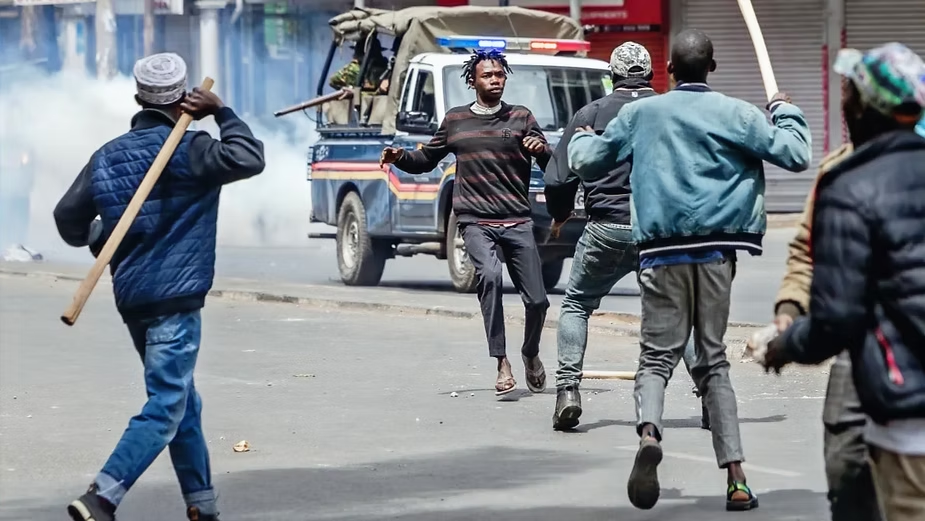
Political tension has been rising since January. Opposition political rally organizers have faced several acts of intimidation and violence. Since that horrific 30 June 2025 rampage by goons in Nairobi that left vendor Boniface Kariuki dead among others, several political events have been disrupted with little accountability. During the 25 January attack on the Witima ACK Church, former Deputy President Rigathi Gachagua, allies, and supporters were pelted with stones, and their vehicles were vandalized in the presence of police officers who made no arrests then or since. Last week, Samburu Governor Lelelit was roughed up by Senators outside the National Assembly gates.
A dangerous pattern of normalized political violence and impunity is growing. With it, the reputation of the National Police Service leadership as a neutral, non-political party-aligned service dedicated to public safety and human rights is splintering. Opposition politicians rightfully point to the ease with which UDA can hold peaceful rallies in contrast to those of the United Opposition and ODM-Linda Mwananchi. While their anger is directed at the Police Inspector General, it is not just Douglas Kanja who is on trial. The very independence of the National Police Service is at stake. Removing the individual and retaining the culture of state capture and “orders from above” will not transform an increasingly unstable situation.
Kenya urgently needs clear, enforceable, and rights‑respecting security measures for all political activities. A truly independent police service would conduct early threat assessments for politicians at risk. Instead of blanket deployments, trained close‑protection units would accompany leaders into high‑risk situations. Clear and objective rules for protection would be standardized to prevent security being increased or withdrawn as a form of reward or punishment. Non-recurrence is only possible through arrests of both assailants and bosses. Commanding officers must be held accountable for all failures to act despite warning signs.
Parliamentary oversight committees must summon the Cabinet Secretary, the Inspector General, and the IEBC over the Osotsi incident. They must also demand an election-related security management strategy now. All political parties must publicly renounce violence, gangs for hire, and introduce campaign codes of conduct.
The assault on Senator Osotsi is not just an attack on an individual. It is an attack on Kenya’s democratic space. I wish the Senator a quick recovery, and his attackers and those who sent them, a day in court as soon as possible.
Irũngũ Houghton is Amnesty International Kenya Executive Director and writes in his personal capacity. Email: [email protected]